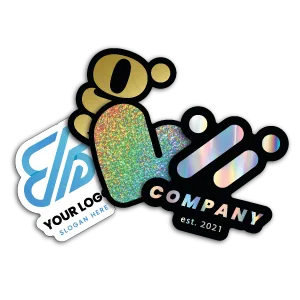
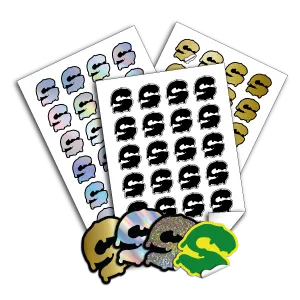

The holographic effect is the play of iridescent colors that changes as you turn an object. It is not a printed color: it is split light. A micro-embossed surface breaks white light into its components, as a prism does, producing reflections that shift with the viewing angle.
On a sticker or label, the effect is not created with ink. It is created by starting with an already holographic substrate and printing on top of it. This changes how the artwork must be designed, and it is why the same file can turn out spectacular or flat.
| In brief | |
|---|---|
| What it is | Iridescence caused by light diffraction, not a color |
| How it is produced in print | Holographic substrate + printing on top (or hot-stamped foil) |
| What diminishes it | Dark, opaque colors that mute the reflection |
| What enhances it | Unprinted areas, fine lines, and light tones |
| Where it works best | Direct light and objects that move or are handled |
Hologram or holographic effect? They are not the same thing
It is worth clearing up a misconception right away, because almost everyone uses the two terms interchangeably.
A true hologram records the entire light wavefront of an object using coherent light (a laser). Viewed correctly, it recreates a three-dimensional image with real parallax: as you move, you can actually see behind the object. This is the technique Dennis Gabor described in the 1940s, which earned him the Nobel Prize.
The holographic effect of the materials we use in printing is something else: it is iridescence caused by diffraction. The substrate has a microscopic surface structure that separates light into a spectrum of shifting colors. It is beautiful, but it contains no three-dimensional information.
In practice: no commercially available holographic sticker is a hologram. It is an iridescent material. Anyone selling it as a "3D hologram" is using the term incorrectly—which is fine in everyday speech, but much less so when you are evaluating a supplier.
Security holograms are the exception—the anti-counterfeiting features found on banknotes, medicines, and warranty seals. Those are real holograms, produced with dedicated masters, and belong to a technical market completely separate from custom stickers.
How the holographic effect is created on stickers and labels
There are three approaches in printing. They differ in cost, appearance, and minimum quantities.
1. Printed holographic substrate
The process starts with an already iridescent material—typically a metallized vinyl or polypropylene with a microscopic structure—and the artwork is digitally printed on top. The effect is present across the entire surface and shows through wherever ink does not cover it.
This is the most direct approach, the most affordable for short runs, and the one that allows unrestricted shapes and sizes. It is the method StickyAttack uses.
2. Holographic hot foil
An extremely thin film is applied with heat and pressure only where needed: a logo, lettering, or a rule. The rest of the label remains standard.
The result is very elegant and distinctly premium, but it requires a dedicated die for each design. That means setup costs and makes it cost-effective only for medium-to-large runs. This is the typical method for high-end packaging labels.
3. Applied holographic film
An adhesive iridescent film is applied above or below the artwork, generally for large formats or windows. It is less common on small stickers, where the labor cost is hard to justify.
| Method | Effect | Ideal run size | Setup cost |
|---|---|---|---|
| Printed substrate | Across the entire surface | From a few dozen pieces | None |
| Hot foil | Only on selected details | Medium to large | Die for each design |
| Applied film | Large areas and large formats | Variable | Labor |
Why colors look different on holographic material
This is the point that determines everything, and the one almost nobody explains before asking you to order.
On white paper, ink sits on a neutral background, and the color comes out as you see it on your monitor. On a holographic substrate, the background is not neutral: it is mirrored and color-shifting. Digital ink is semi-transparent, so the substrate’s reflection passes through the color and changes it.
There are three practical consequences:
- Light and pale tones become more vivid. Pink, light blue, lilac, and yellow become iridescent and produce the most striking result.
- Black and dark, solid colors mute the effect. They cover the microscopic structure: beneath a solid black area, the holographic effect simply disappears.
- White areas are the key issue. If you leave an area white in the file, nothing is printed there: the bare holographic substrate remains visible. If you want a solid, opaque white instead, you need a dedicated white-ink layer, which must be requested explicitly.
The same logic applies to transparent stickers: on a non-white substrate, white stops meaning "nothing" and becomes a color that needs to be managed.
How to prepare the artwork: 5 practical rules
- Design around what you leave unprinted. The areas without ink are the ones that shine. Holographic material is not a background: it is a design element to use as negative space.
- Avoid full-page dark fills. If the design is dark, consider another material—you would be wasting the holographic substrate.
- Use fine lines and outlines. A thin stroke over an iridescent background offers excellent legibility and contrast.
- Build the file in CMYK, not RGB. Iridescence cannot be simulated on a monitor: what you see is not what you print. If you need a refresher, see our guide to CMYK and RGB.
- Ask for a proof and, if possible, a physical sample. With holographic material, photos and screens are always misleading. It is the one material you need to see in your hand.
Stickers or labels: what is the difference?
The difference is not aesthetic; it is about the intended use.
With a holographic sticker, the iridescence is the product: stickers for brands and creators, laptops, water bottles, helmets, skateboards, limited-edition packaging, and sticker packs. Here, the effect should stand out, and a fully printed substrate is the right choice.
On a product label, holographic material works better as a detail: an iridescent logo or rule over a restrained background. This is the language of premium packaging—cosmetics, spirits, and special editions—and hot foil is the typical process. This applies to both stickers and custom labels.
One common mistake is using holographic material across an entire food or cosmetics label packed with required text. The iridescent background makes ingredients, batch numbers, and expiration dates hard to read. If the label must carry regulatory information, keep it in an opaque, legible area.
Where the holographic effect really works
- Stickers for brands and creators—this is the most requested material for sticker packs because it stands out from the crowd.
- Limited editions and merchandise—iridescence communicates "rare" without having to say it.
- Party favors and events—the effect is strongest on small objects that are handled because it changes constantly.
- Branded closures and seals—an iridescent touch on a box elevates the unboxing experience.
- Not recommended for surfaces that remain still and in shadow: in darkness or diffuse light, the effect practically disappears.
If you are looking for another specialty material with the same impact, take a look at glitter stickers: they interact with light differently but offer the same dramatic appearance.
How to order a holographic sticker
At StickyAttack, holographic is a product finish, not an add-on option: choose the shape, size, and quantity, upload the file, and the price updates in real time. You can configure your custom holographic stickers directly online.
- Shapes: die-cut, square, rectangular, rounded corners, round, or oval
- Sizes: from 3×3 cm to 12×12 cm, or a custom width × height
- Quantities: from 50 to 5,000 pieces
- Price: from €28.09 including VAT (5×5 cm die-cut, 50 pieces)
- Production: 2–3 business days, with free shipping in 24–48 hours
Before printing, you always receive a free proof by email or WhatsApp, and production begins only after you approve it. If the file needs to be fixed or adapted, our graphics department takes care of it at no additional cost.
One tip before ordering: if you have never seen holographic material in person, get the €2 sample sticker pack—it includes two holographic stickers along with the other materials. For this effect, it is the fastest way to understand whether it matches what you have in mind.
Frequently asked questions
What is the difference between a holographic effect and a hologram? A hologram is a three-dimensional recording created with laser light that shows real parallax. The holographic effect on stickers is iridescence caused by diffraction: a microscopic structure in the substrate splits light into colors that change with the angle. It is an optical effect, not a 3D image.
How is the holographic effect created on a sticker? The artwork is printed on an already iridescent substrate. The effect remains visible in every area the ink does not cover. Alternatively, holographic hot foil can be applied to only a logo or lettering on labels.
Can any color be printed on a holographic sticker? Yes, but the result changes. Light and pale tones become more vivid and iridescent; dark, opaque colors mute the effect because they hide the substrate. Areas left white in the file remain bare holographic material.
Can you see the holographic effect in the dark? No. Iridescence comes from light hitting the surface: without light, there is no effect. It performs best in direct light and on objects that move or are handled.
How much do custom holographic stickers cost? At StickyAttack, prices start at €28.09 including VAT for 50 die-cut 5×5 cm stickers, with free shipping. The price drops significantly as the quantity increases, and it updates in real time in the configurator.
Can I have the holographic effect on only part of the design? Yes, but it depends on the process. With a printed substrate, the effect covers the entire surface and is "cut out" by leaving selected areas of the file unprinted. Applying holographic material only to a logo or lettering requires hot foil, which has higher setup costs.